Local History


Town of Creighton


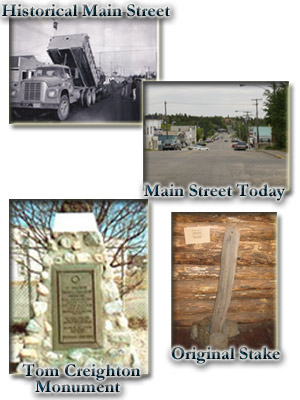
Creighton is a vibrant community with an intriguing past and promising future. It was named after Thomas Creighton, a prospector who came to the area in the early 1900s. He staked a claim on the Flin Flon Lake ore body in January 1915. This became the original producing mine for the Hudson Bay Mining & Smelting Company, the area's major employer.

Although Tom Creighton sold his shares to this property in 1922, he continued to seek out new adventures and spent the latter part of his life in the community named after him.

After WWII, the Saskatchewan Department of Natural Resources surveyed a town site, and residential/business property became available. The Town of Creighton was incorporated as a village in 1952, and was raised to town status in 1957.



Beaver City


Saskatchewan 's first gold rush started in 1913 when Tom Creighton discovered gold on Amisk Lake. Eager prospectors quickly established Beaver City near the Hudson Bay Post and warehouse on the south shore of the lake. Kate Rice, one of Canada 's earliest female prospectors began her career at Beaver City. At it's height Beaver City included Federal Government Ranger Station and fire tower, Revlon Frere's Trading Post, Hayes Boarding house, Royal Northwest Mounted Police Post and Colette's Boat Ferrying service. With the onset of WW 1, interest in gold waned as demand for copper increased significantly. By 1918 most inhabitants had left Beaver City for nearby Flin Flon, where copper was discovered in 1915. Beaver City quickly became a ghost town, never to recover.


Tom Creighton


Tom Creighton was born in Barrie , Ontario . Little is known of his early life but his adventurous spirit eventually led him north. It is known that he was commercial fishing at Candle Lake in 1911. Perhaps it was here that he first met Dan Mosher, who was homesteading in the Paddock wood area, just north of Prince Albert. They joined forces and using Tyrell's favorable geological reports, began prospecting in northern Saskatchewan.

The prospectors used the railroad to reach the Pas, from there they traveled west down the Saskatchewan River to Cumberland House, north across Namew Lake to Sturgeon Landing and finally navigated the Sturgeon Weir River to arrive at Fort Henry, a Hudson Bay Post on the southern shores of Amisk Lake.

It was while prospecting in this area in 1913 that Creighton and his partners (Dan & Jack Mosher, Leon & Isadore Dion & Dan Milligan) for gold on the northwest side of Amisk Lake . This triggered Saskatchewan's first gold rush and soon over a 1000 prospectors were in the area hoping to "hit pay dirt". In response to this activity, J.E. Hammell, a mining promoter for Ontario , had plans of developing a community ( Beaver City ) adjacent to the post.

Business men in Prince Albert , who had backed Tom Creighton & Dan Mosher, made large profits on these staking activities. They quickly established, The Beaver Lake Gold Mining Company and began working the property. Tom Creighton ended his relationship with this group because they were more interested in developing a paying gold mine than seeking out additional claims.

Tom Creighton was now forced to look for a new partner. Jack Hammell, always the opportunist, was quick to step up and offer his services. Jack Hammell and Tom Creighton believed in each other. This belief would take them for gold on Amisk Lake to the copper sulfides of Flin Flon Lake and beyond.

In 1914, however, Jack Hammell desperately needed producing mine properties to sustain his investment in Beaver City . Creighton and his partner expanded their search to include copper as well as gold because demands of WW1 had caused huge increases in prices.

According to William E. Dodds (who claimed to have been present) it was December 1914 when Tom Creighton stopped at David Collin's camp on Athapapuskow Lake . Collins showed him rock samples from mineralized outcrop on his trap line. Creighton was so interested in these samples that he asked to be taken to the site. Tom Creighton staked a claim on this property in January 1915.

Creighton and his partner spent most of that winter hauling mining and milling equipment form The Pas to Beaver City . It was after breakup that they returned to the mineralized outcrop on the east side of what they later named Flin Flon Lake . After some preliminary work they realized that they had found a large low grade copper sulphide deposit.

The group, which included Jack Hammell, had visions of mining the property themselves but the ore body was extremely complex and costly to develop. They soon realized that they would require large amounts of outside capital and began searching for new investors. To prevent a staking rush (such as what happened at Amisk Lake ), they kept the discovery to themselves. In May 1915, Dan Mosher went to Toronto and returned with Frank Currie (a former partner in the Otisse-Currie Mine at Elk Lake ). Jack Hammell replaced Dan Mosher as the group's negotiator with outside investors and between 1915 and 1922, this property was held by or was under option to numerous mining concerns.

They must have felt time and luck were running out as one investor after another abandoned them. Isadore Dion and Dan Milligan sold their interest in 1918. Hammell and Creighton held on until 1922 and then sold to the 'Complex Ore Recoveries Company".

After selling his share, Tom Creighton didn't retire but continued to seek out new adventure and spent the latter part of his life in the community that was named for him. There is a cairn on the Creighton School grounds that is dedicated to him and it reads:

"His wants were few, His habits simple, The bush his wide domain."


Amisk Lake


A Route for Frobisher and Franklin

On many mornings Amisk Lake is enveloped in mist. Through this mist of time come the echoing sounds of freight canoes gliding between the many islands. Slowly the mist lifts, revealing Amisk Lake 's rich and varied history.

In the mid 1700's, the Hudson Bay Company was in threat of losing its fur trade monopoly. "Montrealers," who had inherited the fur trade of New France , were quickly pushing into their areas. In a short time they had built so many trading posts around Lake Winnipeg that the Hudson 's Bay Company had to abandon its traditional method of waiting on the coast for the fur to come to them.

Under the experienced direction of Samuel Hearne, the HBC established their first western inland post at Cumberland House in 1774. The Hudson 's Bay Company had begun to react to the challenge of independent traders. After the fall of the French on the Plains of Abraham - men like Alexander Henry Sr., the Frobisher Brothers, McGill and Peter Pond joined forces to compete with the Hudson Bay Company and formed the North West Company, which had its head quarters in Montreal .

In 1774, under the direction of Samuel Hearn, the Hudson Bay Company reacted to the challenge by the independent traders by building its first western inland post at Cumberland House. One of the independent traders, Alexander Henry Sr., had come north from the American colonies. He quickly realized the only way to compete with the powerful Hudson Bay Company was to organize the HBC and formed the North West Company, which had its head quarters in Montreal . Their goal was to cut into the monopoly held by the Hudson 's Bay Company, who for over 100 years had enjoyed unrestricted trade with the native peoples carrying their furs down the Churchill River system to Hudson 's Bay. The Sturgeon Weir River and Amisk Lake located just up river from the HBC's first inland post at Cumberland House, would figure prominently in the North Westerns early plans. Alexander Henry Sr. was the first explorer of note after the conquests of the French in North America by the British. Their goal was to cut into the monopoly held by the Hudson's Bay Company, who for over 100 years had enjoyed unrestricted trade with the native people carrying their furs down the Churchill River system to Hudson 's Bay.

The sturgeon Weir River and Amisk Lake , located just up river from the HBC's first inland post at Cumberland House, would figure prominently in the North Western's early plans. Alexander Henry Sr. was the first explorer of note after the conquest of the French in North America by the British. He came North from the American Colonies as an independent trader, and quickly recognized the only way to compete with the powerful HBC was to find a means of organizing the many independent traders-and this led quickly to the formation of the North West Company.

The NWC's goal was to subvert the flow of furs away form the HBC at Cumberland House by advancing an expedition upstream to the headwaters of the Churchill River. In 1774, Henry along with the Frobisher Brothers began their attempt to outflank the HBC and pushed an expedition to establish territory and strengthen their trade north of Cumberland House from Amisk Lake to Isle a La Crosse . An early winter stranded the party and they were forced to winter over on Amisk Lake , food became so short, Joseph Frobisher lived part of that winter chewing pelts. There were also rumors of cannibalism, but most importantly, they successfully intercepted the supply of pelts which had otherwise been destined for Cumberland House.

The Northwester's had established a foothold and in so doing, deprived the HBC of much of the fur trade that year. The hardships associated with this first expedition reinforced the Northwester's desperate need to establish a permanent base in the region. Accordingly, in 1775 Henry built his first post on Amisk Lake at one of the sites where he and the Frobisher's had been forces to winter over.

By 1776, Henry had a series of posts spread all along the water route from Amisk Lake to Isle a La Crosse , effectively corralling the fur trade from the HBC. The HBC responded by constructing their own posts adjacent to Henry's setting a pattern that would see HBC and NWC constructing competing posts until they eventually reached the BC coast.

With the NWC's presence well secured, the Frobishers returned to their Montreal headquarters, leaving Henry to tend to the various posts until his retirement on 1791 when he returned to Montreal. In Dr. Bruce's geology report of 1915 he commented on the existence of both Fort Henry and one of the winter campsites, but he failed to pinpoint their exact location on Amisk Lake. Then in the 1950's, Harry Moody, an amateur archaeologist, and Tom Welsh went on a search.

On the North side of Amisk, they found in the water, steel bladed barber scissors and some copper or bronze handles. Moody believed he had evidence of Frobisher's winter camp. He developed the theory that the Frobishers, in 1774 had traveled up the east side of the lake where they were blind ended. When they turned west they ran into some ice and were forced to land where the terrain was suitable. This placed them on the north end of Amisk Lake .

Later Moody was to make another discovery with the help of George Custer, which would lead him to the actual site of Fort Alexander Henry. Half way up Amisk Lake , they beached their boat. Custer showed Moody a large poplar tree growing out of a chimney. We removed the earth and found it was a U-shaped fire place built with flat rocks and all with clay like plasters," wrote Moody.

In 1954 with the assistance of Rod McDermott, Moody was able to excavate the site where he believed the old fort to be. He photographed six fireplaces, which had indeed belonged to the fort. They also found a flask, scissors, home made rivets, sheet iron and cooking vessels. ( In the intervening year's following Moody's discovery, the forts actual location was again "lost", and only rediscovered in 1994 during an archaeological survey).

Amisk Lake was also part of the route Sir John Franklin took in his two arctic overland expeditions. The first expedition was in 1819 and the second in 1827. Franklin and his expedition journeyed to the Arctic Coast via Cumberland House, across the Methye Portage and up to the Great Slave Lake . This route took him across Amisk where it is believed he over wintered. Franklin 's orders were," to explore the Northern coast of America , from the mouth of the Copper mine River to the Eastward".

Items were found on the North West side of Amisk Lake at a place, which might have been occupied by a survey and foraging party, possibly in the winter of 1819. Many of Franklin 's men were Navy personal. A belt buckle found had emblem markings indicating that it was of Navy origin, (currently on display at the Denare Beach Museum .)

Pierre Burton in his book, "The Arctic Grail," recounts the exploration. Franklin 's first expedition succeeded in mapping 50 miles of the North American coast east of the Copper mine; otherwise the expedition was a disaster. Franklin 's expedition from the beginning suffered from acute shortages of supplies. When they arrived at the Copper mine in July 1821 their supplies of ammunition and food were critically low. The party was reduced to 20 men and two canoes. On August 18 Franklin decided to turn back.

The voyageurs were close to rebellion. The two canoes were too badly damaged to return by water. They would have to walk if they wished to survive. Their main diet had become lichen. Nine men died of starvation or exposure. A man later suspected of cannibalism shot midshipman Robert Hood Surgeon and naturalist John Richardson was given the task of executing Hood's attacker.

When the party eventually reached Fort Enterprise they found that the natives there had not stocked it with food. Forced to survive on bones and skins, they were finally rescued by passing natives, who took them to Fort Providence.

Franklin quickly became know in the British Empire as the man who had eaten his shoes. In total, 11 members of his expedition died. In hind site, questions have been directed towards the choice of Franklin leading an expedition where hardships would have been the norm. Burton writes that, "In 1819 Franklin was 33 years old. He was plump and unaccustomed to hard exercise and an inexperienced inland traveler"

By the time of Franklin 's second overland expedition, which was better organized and more successful, the Hudson 's Bay Company had amalgamated with the North West Company and they were anxious to forestall the Russians, who were making significant inroads in the fur industry on the Alaska Seaboard.

To do this they needed to map and explore the Arctic Coast by ship for a North West Passage. And so in 1845, encouraged by the HBC, the British Admiralty sent Franklin, who was considered to be their best choice for the hazardous Arctic journey, even if he was 59 years of age and well past his prime.

In 1847, when Franklin's 1845 sea expedition had finally been reported missing, Kennedy, a man from French-Cree heritage, and Joseph Renee Ballot, an ex-French officer, under funding from Jane Franklin, went overland to the Arctic to find him. They failed.

Kennedy, when he was only 5 years of age, had met Franklin upon his first stop over at Cumberland House. His memories were of a kindly man who taught him his ABC's and preached at the local Church.

The search for Franklin went on until 1857 when his fate was finally confirmed. He and his entire crew had perished after abandoning their ice bound ships on the Arctic Ocean . While Franklin had died on the frozen sea, some of his crew actually made landfall at the Blackfish River and were no doubt using the maps he had prepared during his earlier overland expeditions form Cumberland House.


Hanson Lake Highway


Official opening ceremonies 1965

Completion of the Hanson Lake Highway , 106, as it is commonly known today, was cause for considerable celebration at its official opening in 1965.

Dignitaries from both Saskatchewan and Manitoba marked the event with Main Street ribbon cutting ceremonies in Creighton, the culmination of over 30 years of effort to provide an all Saskatchewan road link to the mineral riches of the Creighton/Flin Flon area.

Finally constructed as part of Prime Minister John Diefenbakers, "Roads to Resources", program, the Hanson Lake Highway reflected longstanding interests in providing road access to this important region.